
Person-Centred Creative Therapy Models
The foundations of our person-centred pluralistic creative arts approach in APCCA are the four key person-centred creative therapy models:
- CCPT – Client-Centred Play Therapy – Virginia Axline
- PCEAT – Person-Centred Expressive Arts Therapy – Natalie Rogers
- FOAT – Focus Oriented Art Therapy – Laury Rappaport
- PCAT – Person-Centred Art Thearpy – Liesl Silverstone
These approaches were created by women not known well enough, not appropriately recognised, and much criticised by the academic world.
All these models are based on the key principles of Rogers’ person-centred approach. They argue that the six therapeutic conditions are necessary but not sufficient. Creativity is a key in all of them. By using creative materials and methods, by offering stimulating and challenging experiences, the therapeutic process of change can be enhanced. The relationship between the curious and motivated client and the therapist who is offering the core conditions is also key in the process of connecting with the unconscious and client’s inner wisdom.
Each approach has key differentiating features of practice.
CCPT – Client-Centred Play Therapy – Virginia Axline
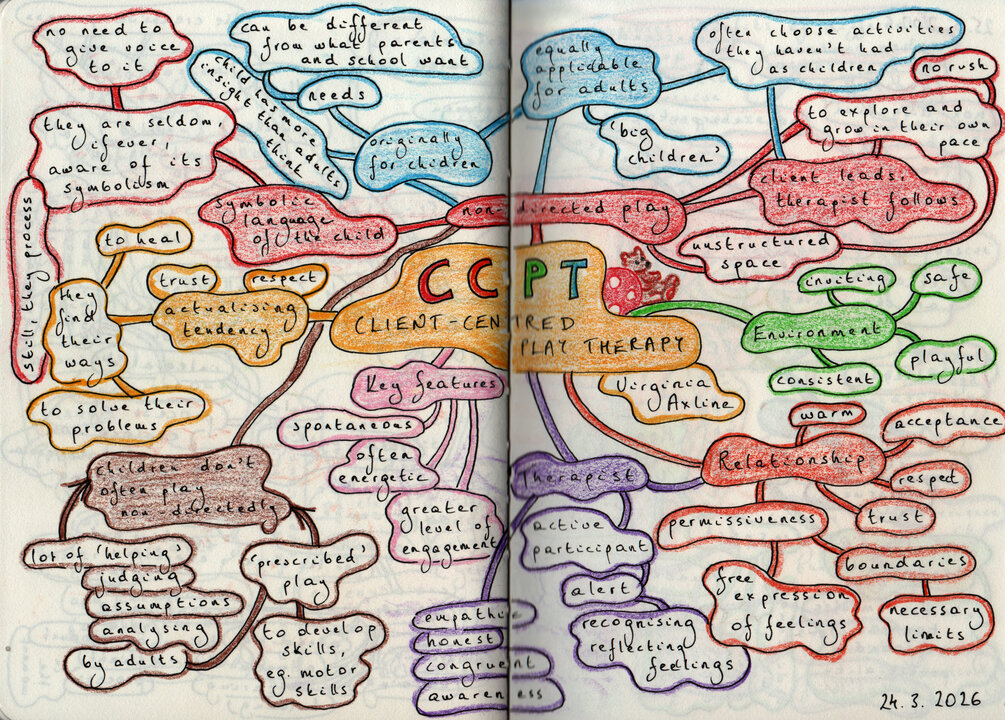
Play therapy was originally designed for working with children, but it is equally applicable with adults. For the simplicity’s sake, I will use the word ‘child’ here when describing this method.
Play, when it is not directed, is the language of the child, their way of expressing and processing their feelings and thoughts, the symbolic expression of their internal world and process, although they are seldom, if ever, aware of its symbolism.
There is very little opportunity for a child to play in a non-directed way, most of the time, adults make assumptions of their play, they ‘help’, instruct, judge, analyse, or even prescribe a specific type of play to develop specific skills.
In play therapy, the child leads, the therapist follows. The therapist trusts the child’s actualising tendency, their capability to finding ways to solve their problems and heal themselves. The child’s needs are often very different from the reasons of the parents and schools for sending the child to play therapy.
The environment needs to be safe and playful, inviting and consistent.
The relationship between the child and the therapist needs to be warm and permissive, built on trust, respect, acceptance. The therapist is an active participant here, empathic, honest, congruent, and alert to recognise and reflect feelings without interpretation, so the child is free to express their feelings, explore and grow in their own pace. The therapist mustn’t rush the process. They have to define and communicate only the necessary boundaries to keep the participants and the environment safe.
Play therapy is spontaneous and often energetic, it offers a greater level of engagement. Adults too, who are basically just big children, can greatly benefit from it.
PCEAT – Person-Centred Expressive Arts Therapy – Natalie Rogers
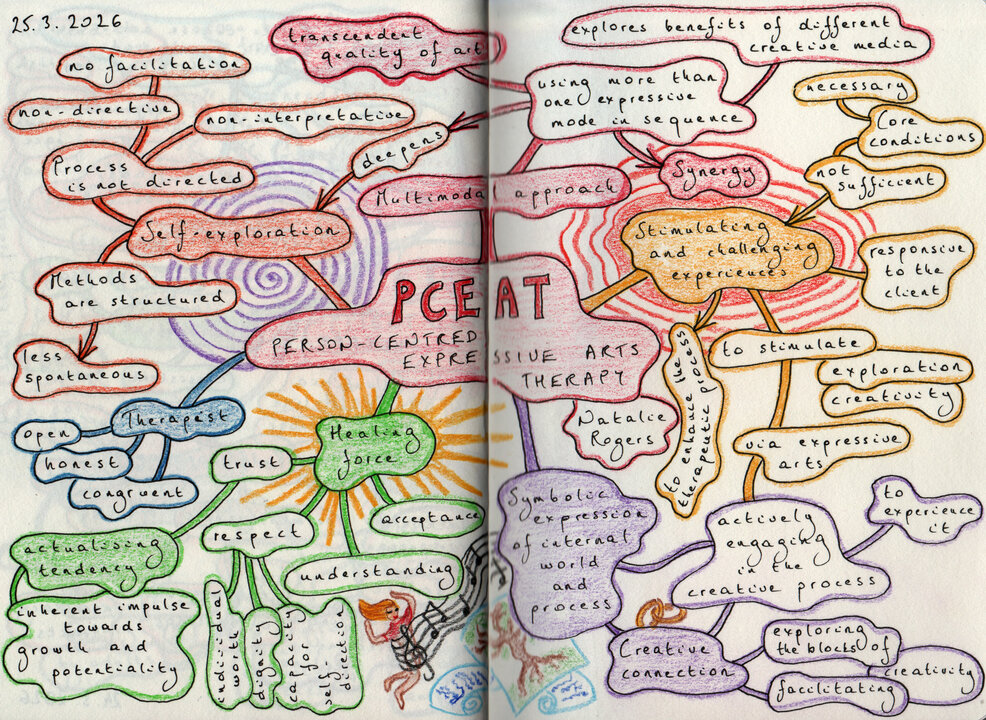
Natalie Rogers argued that the six therapeutic conditions are necessary but not sufficient. Her multimodal approach offers stimulating and challenging experiences, responsive to the client. It uses different expressive art modes in sequence, creating synergy, to enhance the therapeutic process, deepening self-exploration, discovering the benefits of different creative media. The process is not directed, there is no facilitation, but the methods are structured, therefore less spontaneous.
The client explores and symbolically expresses their internal word and process by actively engaging in the creative process, experiencing creative connection and the transcendent quality of art.
FOAT – Focus Oriented Art Therapy – Laury Rappaport
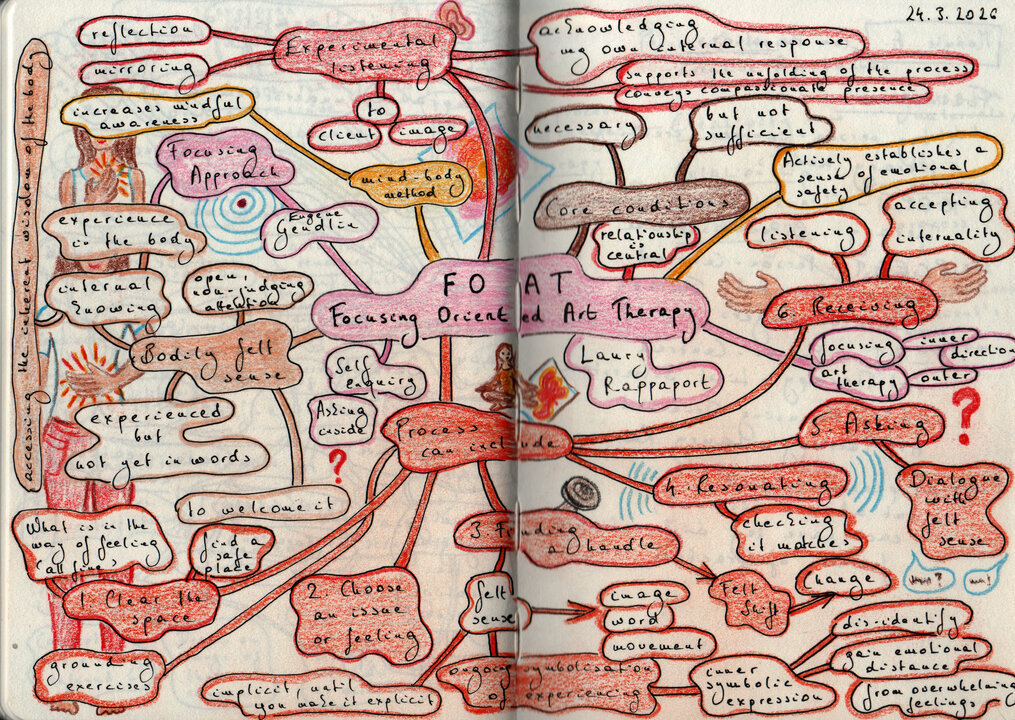
Laury Rappaport combined Eugene Gendlin’s Focusing Approach, the inner direction of focusing, with art therapy, the outer direction, in this mind-body method. This self-enquiry is about asking inside, becoming aware of our bodily felt sense that is experienced but not yet in words, being open to our internal knowing, welcoming it with non-judging attention, accessing the inherent wisdom of our bodies with mindful awareness.
This process can include:
- Clearing the space: finding a safe place, and ‘clearing out’ physically and mentally all that is in the way of feeling ‘all fine’. Grounding exercises can help.
- Choosing an issue or feeling to work with.
- Finding a ‘handle’: an image, word or movement for the felt sense, ongoing symbolisation of experiencing, inner symbolic expression. Leading to felt shift and change.
- Resonating: checking if they match.
- Asking: dialogue with the felt sense.
- Receiving: listening and accepting it internally.
The therapist experimentally listens to the client and the expression, reflects and mirrors, conveys a compassionate presence, supports the unfolding of the process, while also acknowledges their own response.
PCAT – Person-Centred Art Thearpy – Liesl Silverstone
Liesl Silverstone identified five stages of the therapeutic process that are fluid, not a linear process:
- Symbolisation: an image manifests.
- Externalisation of it in art form.
- Verbalisation: sharing the meaning, reflecting, empatising, bridging.
- Dialogue with the image, using advanced skills.
- Working with the revealed meaning, making use of insight.
The first two stages represent art as therapy in itself. The next two stages represent art in therapy.
Facilitation in advanced level includes:
- reflection, bridging, wider bridging
- non-directive, non-interpretative exploration of the whole image
- seeing connection between different aspects and elements of the image: proportions, missing things, unintentional marks, number of elements, groupings, colours, same colours, paper size and colour, qualities of creative media used
- curiosity about the process and the art product
- capacity for depth, respect for what is and what isn’t verbalised
- ability to work with the whole image in more depth
- awareness of multiple and multi-layered meanings
- facilitating understanding of the essence of the message: What is it saying? Why now? How does it relate to the client’s current situation?